

Anjana Data breaks the ice: Data Mesh and Data Fabric
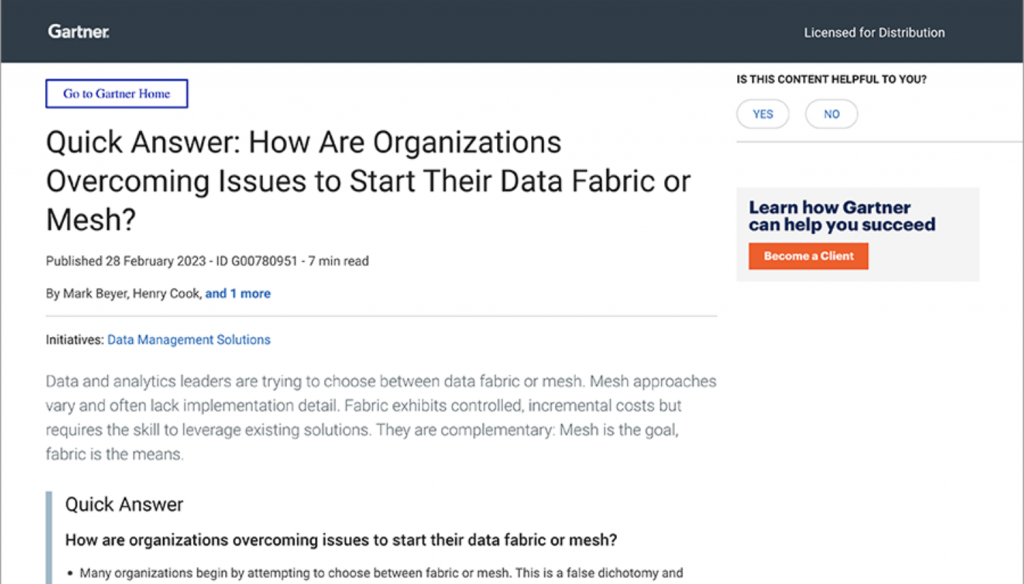
From Anjana Data we were very eager to present the document to you ‘Quick Answer: How Are Organisations Overcoming Issues to Start Their Data Fabric or Mesh?’ from Gartner, It covers two of the hottest topics in the Data Management community and has been discussed by several of our analysts during their participation in round tables at events. Therefore, taking advantage of this article from Gartner, we would like to focus on this topic and tell you our vision about it.
According to its own definition, Data Mesh y Data Fabric are two concepts linked to data architecture and infrastructure that aim to improve the management and integration of data between different systems, applications and users. Most organisations think they have to choose between Data Fabric or Data Mesh; but, according to Gartner (and we think so too), this is a false dichotomy and should be avoided: work both separately and together, The value they can bring together is much greater than separately: Data Fabric approach to the challenges from a point of view closer to the technological platform (technology as a medium) and Data Mesh is more oriented towards vision of how our work has to be data architecture to be able to generate data products (the ultimate goal is the creation and management of data products to generate value for the organisation).
In this sense, both Data Fabric and Data Mesh benefit more from considerations not only of the data, but also of the existing infrastructure in order to eliminate «rip and replace» thinking by «rip and replace" thinking.«use and reuse»The existing infrastructure components. Despite what many believe (mostly due to lack of knowledge) and what many transmit (obviously due to their own interests), nowadays for organisations to be able to start obtaining value from data, it is not necessary to simply throw away everything that has been built for years at the infrastructure level and with different technological pieces, but rather to think that it was done at the time for a reason and the first thing we have to do is evaluate whether it still makes sense within the new ecosystem that we want to build. And this is not only a matter of return on investment (it must have cost a lot of money to do this and it has not yet been fully profitable) but also for a matter of efficiency y change management It will always be much easier to manage small incremental changes or additions to the current ecosystem than to deal with gigantic changes involving a clean slate.
Thus, Gartner proposes that each organisation should carry out a holistic analysis of its data ecosystem In this analysis, identify the specific domains or areas in which the Data Fabric concept can best fit, identifying the potential risks for each case, but above all the expected improvement points to achieve the objectives and thus the derived benefits. In parallel, the same should be done with the Data Mesh concept and then both analyses should be brought together to decide in which cases a joint approach will be implemented and in which cases separate approaches will be implemented.
After all, as the professionals of Anjana Data have defended on different occasions, it is a matter of creating a ‘...'.‘bespoke suit’To do this, it is first necessary to carry out a good analysis of the current situation we have and the future situation we want to reach because, as they say, “one size never fits all”. Here the recommendation is always to have a clear strategy and go little by little (think big, start small) and not try to make a gigantic Big-Bang, as with the implementation of any Data Governance initiative. And since we are talking about Data Governance, this also has a lot to say in the Data Fabric and Data Mesh approaches as these will always have to be aligned with the Data Strategy and with everything defined at the Governance level (Operating Model, Policies, Procedures, Standards, ...). That is why it is important that when we want to tackle Data Fabric and/or Data Mesh initiatives we review everything defined in terms of governance and analyse their impact because we will not only have to follow what is marked but we will probably need to review existing policies, evolve our operating model (especially with Data Mesh, which proposes a federated model) and design new procedures and standards for our ecosystem.
Talking about the impact this can have on Data Governance and how relevant it should be for an organisation, we realise how important it is to have not only a Data Office in place, with the different mechanisms needed to ensure proper data governance and the involvement of the different areas and stakeholders involved in data management, but also how important it is to have a flexible technology platform that allows you to face all these challenges with guarantees from a business-oriented vision and with an agnostic approach to data processing technologies.
Therefore, although the concepts of Data Fabric and Data Mesh have become fashionable now, Anjana Data was already conceived with this type of approach and its philosophy in mind, and this is something that makes it truly different from other types of existing solutions on the market. We all know that when we talk about “Data Governance”, buying technology does not solve the problem far from it, and having a specific tool is not enough (it is not even necessary to start the initiative), but having the right tools is not enough. correct technological parts in our architecture stack can be a very decisive factor when we really want to scale our governance initiative and grow in data management maturity (let's not forget that concepts such as Data Fabric and Data Mesh require a minimum of data management maturity to be successfully implemented).
With Anjana Data we can have all the guarantees of having a fully flexible and business oriented Data Governance & Analytics Platform, which allows us to integrating both concepts of data architecture in our ecosystem in a completely agnostic way to the rest of the technology pieces and aligned with a proactive and preventive governance model suitable for any organisation regardless of its level of maturity in terms of data management. We can say that Anjana Data is the perfect technological ally for organisations that really want to succeed with their Data Fabric and Data Mesh initiatives from a business point of view.
As mentioned above, Gartner presents Data Mesh as the target y Data Fabric as the medium, Both are complementary and necessary. Find out all the details about these two concepts through the document ‘Quick Answer: How Are Organisations Overcoming Issues to Start Their Data Fabric or Mesh?’.