

Anjana Data Platform 26.1: a new end-to-end data governance and AI experience
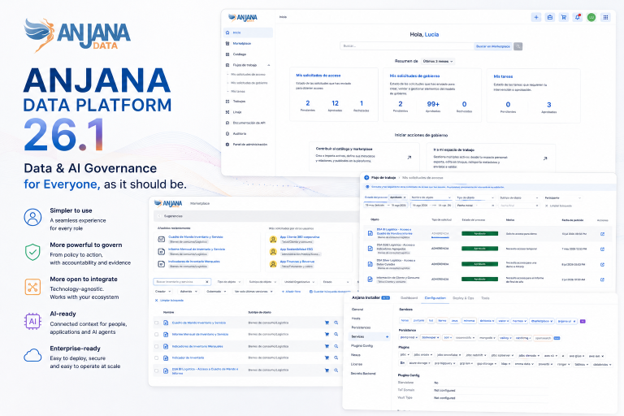
Simpler for the user. More powerful for the Government. More open to integration. Better prepared for AI. Easier to implement.

Data and AI governance should not become a new source of complexity. It should help organisations to better understand their assets, build trust, reduce risks, make better decisions and ensure that their data, AI and knowledge products can be shared, used and activated in a secure, traceable and controlled manner. But to achieve this, there is one fundamental condition: The Government must work for everyone.
This means designing an experience that is useful both for those who define the Governance Model and for those who produce and manage Assets, discover and consume them, approve requests, monitor risks or make decisions. And, increasingly, it also applies to the applications, assistants and AI agents that need to access the organisation’s knowledge and context within the same governance rules.
This vision —Data & AI Governance for Everyone, as it ought to be— is behind Anjana Data Platform 26.1, one of the most significant developments we have made to our platform. The new version does more than simply add features: it enhances the end-to-end experience to create a platform that is increasingly powerful whilst, at the same time, being simpler to adopt, easier to operate, more open to integration and better equipped to evolve alongside each organisation.
And all of this ties in with another key idea: Governance That Creates Value. Governance makes sense when it ceases to be an additional layer of documentation and control and begins to improve the way the organisation operates: when it builds trust, reduces risk, facilitates reuse, speeds up access to governed assets and turns policies and responsibilities into real decisions and actions.

The new features in version 26.1 can be understood precisely through the platform’s six dimensions of value —GOVERN · UNDERSTAND · TRUST · SHARE · ACTIVATE · ENABLE—, which work in tandem on Data, AI and Knowledge and enable the Government to take action, from planning right through to implementation and action.
An experience that people can genuinely embrace and make use of
A government platform can only scale when it ceases to be a tool used exclusively by specialists. That is why one of the main focuses of the new version has been to reduce friction for the individuals, departments and teams that need to be involved in government, ensuring that each user group can find what they need to fulfil their responsibilities more intuitively.
The new Home It becomes the entry point from which each user can quickly access searches, recent activity, requests, pending tasks, their workspace or the creation of new Assets. Added to this is a a more granular permissions model which makes it possible to tailor the experience and present each individual with the skills, actions and context relevant to their role. The aim is not to turn the entire organisation into experts in governance, but rather to ensure that Participating in it is part of the natural way of working for each role.

This same philosophy extends to the Knowledge Marketplace. Managing an asset should not be the end of the process: it should make it easier for it to be understood, offered, requested, consumed and reused with confidence. Anjana has been evolving for some time from the traditional concept of a catalogue towards a marketplace where items can be published Data, AI and Knowledge Products accompanied by the necessary context for their use: meaning, responsible parties, policies, agreements, terms of use and traceability.
Version 26.1 marks a significant step forward in this development. The New Marketplace Portal It offers an experience specifically designed for those who need to discover and use approved Products within the organisation: it allows users to search and filter, access recommendations, save favourite searches, view relevant information, request access or add multiple Products to a basket to manage requests collectively.
The key, however, is not just about discovering. The Marketplace provides a simple way to PUBLISH → DISCOVER → SELECT → ORDER → CONSUME → REUSE with the Governance Model, which formalises agreements, approvals, permissions, provisioning, revocation and evidence where appropriate. Thus, SHARING, ACTIVATING and ENABLING cease to be isolated capabilities and are combined to transform discovery into regulated consumption.

From a government defined by its policies to a government that takes action
Many organisations already have governance policies, frameworks, committees and procedures in place. The challenge arises when it comes to ensuring that all of this forms part of actual processes, decisions and operations. Operationalising governance means precisely this: moving from a defined governance framework to one that is actively involved in the day-to-day running of the organisation.
Anjana Data Platform 26.1 continues to enhance this capability. The new interface reorganises requests and validation tasks so that each user can clearly see what they have requested, which processes they have initiated and which decisions are pending. The Workflows provide more context for each request, and the permissions model is evolving to control more precisely which information and capabilities are available to each role. The aim is to ensure that a government decision does not simply end up on a screen or as an approval, but rather that it can to trigger tangible action within the technology ecosystem where the use case requires it.
This operationalisation is also a prerequisite for building trust. Trust does not arise simply because an Asset is categorised: it is built through ownership, accountability, quality, risk, compliance, traceability, controls, audit and evidence. When an organisation is able to ascertain who made a decision, the context in which it was made, the policy under which it was made, what action was taken and what evidence was recorded, governance ceases to be a mere declaration of intent and becomes actual control.

The logic can be summarised as follows: CONTEXT → DECISION → WORKFLOW → ACTION → EVIDENCE and apply to both data governance and AI governance, incorporating use cases, systems, models, agents and other AI-related assets, together with their responsible parties, risks, policies, controls, assessments, decisions and evidence.
This is where integrations cease to be merely mechanisms for exchanging metadata and become an essential part of the A government that takes action. Version 26.1 introduces new features and enhances existing integrations with technologies such as Databricks, Snowflake, Microsoft Power BI and Denodo, amongst others, to bring the Government’s operations closer to the systems where data and users actually operate. This makes it possible to achieve, in an increasingly out-of-the-box scenarios in which Anjana identifies and contextualises assets, makes or coordinates decisions using the Governance Model and its workflows, and initiates actions on specialised platforms, whilst maintaining traceability and retrieving results or evidence where appropriate. It is the difference between integrating technologies and to coordinate them within a single government.

All of this ties in with our vision of Actionable, Proactive and Preventive Governance by Design. The Government should not merely record what has already happened: the context must help determine what should happen next; decisions must trigger workflows, policies and actions; and the results must be fed back to the Government as evidence.
A platform that adapts to the organisation and integrates into its ecosystem
No two organisations are alike. Their structures, responsibilities, policies, processes, technologies, priorities and levels of maturity vary. That is why a governance platform should not force them to adopt a predetermined model: it must be able to adapt to each organisation’s governance model, requirements and architecture without turning every change into a development project.
This adaptability is underpinned by four complementary enablers. SET UP It allows you to configure metamodels, templates, attributes, vocabularies, relationships, workflows, roles, permissions, validation rules and accelerators using no-code/low-code capabilities. INTEGRATE connects Anjana bidirectionally with the business ecosystem. EXTENDER It allows you to add functionality via SDKs, APIs, plugins and custom models without modifying the core of the product. And AUTOMATE It connects the Government with BPMN workflows, notifications, scripts, API calls, interceptors and actions on external systems.
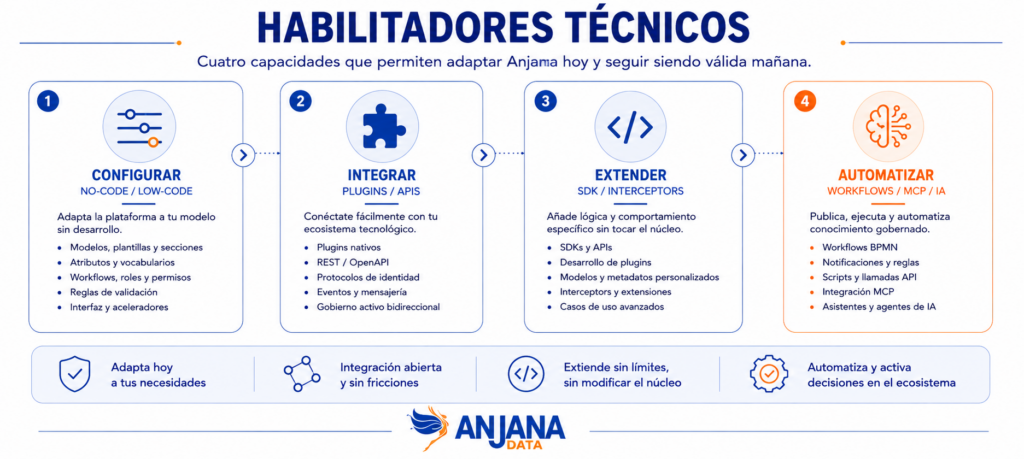
In version 26.1, we have also taken an important step towards implementing that configuration more accessible and more integrated into the product experience. The new Administration Portal It is integrated into the Anjana interface itself and centralises configuration capabilities that enable the Governance Model to evolve without relying on specific developments. In addition, it offers greater capacity for customisation of screens, actions and permissions to tailor the experience to different profiles, responsibilities and ways of working. It’s not just about Anjana being able to work with any technology stack; it’s also about it being able to to adapt to how each organisation wishes to govern and how each user needs to interact with the Government.

This philosophy leads to a key architectural principle: Sovereign and Technology-Agnostic Governance. The Governance Model, the context, the policies, the responsibilities and the decisions must remain under the organisation’s control, regardless of the underlying technology stack. Anjana does not seek to replace IAM, quality engines, MLOps platforms, data platforms or other specialised technologies; it integrates them into the Governance Model, connects their capabilities to the governed context and distributes execution where it makes the most sense.
The idea can be summed up in one sentence: a shared, cross-cutting government with decentralised implementation. Responsibilities can be shared across domains and teams; specialist technologies can implement controls where they are most effective; and the results and evidence can be fed back to the Governance & Control layer to maintain end-to-end traceability.

Connected Context: Preparing the Government for the Age of AI
AI needs data, but to operate safely and effectively within an organisation, it needs much more: an understanding of what assets are, how they relate to one another, who is responsible for them, what level of trust they offer, what policies apply to them, what risks exist and under what conditions they may be used. It requires a connected and governed environment.
Connected Context is the common foundation that links metadata, semantics, relationships, responsibilities, policies, risk, quality, evidence and knowledge through Data, AI and Knowledge. It is not an isolated concept: its value becomes apparent when combined with a configurable governance model and the ability to operate in a distributed manner across the technological ecosystem.
Anjana Data Platform 26.1 also opens up a new way of making this context accessible by incorporating Model Context Protocol (MCP). The first version of Anjana’s MCP server enables compatible assistants to begin interacting with capabilities and context managed on the platform, whilst respecting the same governance model, identity, permissions, policies, workflows and traceability.
The opportunity does not simply lie in connecting an agent to more information, but in enabling them to access, understand and progressively participate in processes governed by the appropriate context and controls. MCP is introduced in version 26.1 as an emerging capability that will continue to evolve. The direction is clear: AI needs context. Connected Context needs governance.
📹 Anjana Data Platform v26 1 · Native MCP
‘Enterprise-ready’ also means better deployment, operation and evolution
The user experience on a business platform does not begin when a user logs in. It also depends on a an architecture designed to evolve, scale and operate consistently, and that deploying, configuring, securing and updating the platform does not create unnecessary friction. That is why Anjana Data Platform 26.1 not only enhances the functional experience: it incorporates significant changes to the technical architecture, deployment model, automation and observability to strengthen their preparedness for complex business scenarios.

One of the most noticeable developments in this evolution is Anjana Installer, a graphical and command-line interface for managing the various stages of the installation cycle in IaaS, PaaS and on-premises environments. The Installer facilitates environment configuration, pre-deployment validations, installation, dependency management, updates, secure credential management, and operation and maintenance tasks. Its capability Preflight enables you to validate connectivity, permissions, resources, ports and packets prior to deployment, whilst the CLI It makes it possible to incorporate these capabilities into automated processes and CI/CD pipelines.
Beneath the surface, the developments are just as significant. The kit Kubernetes has been reorganised around Helm and improvements have been made to TLS automation, secret management, resource profiles by environment and observability using OpenTelemetry, as well as the evolution of numerous internal components. The aim is to have an architecture that is increasingly modular, automatable, observable and capable of operating consistently across different environments and deployment models. Many users will never need to know these details, and that is precisely the point: Sophistication should be built into the platform, not the user experience.

Start with what you need. Create value early on. Scale up when you’re ready.
All this capability may raise a reasonable question: is it necessary to implement it all from day one? No. Every organisation starts from a different position, and there is no single path to maturity. The important thing is to have a platform capable of adapting to the starting point, facilitating adoption, progressively putting governance into practice, and scaling up as new domains, users and use cases emerge.
Our value creation journey can be summarised as follows: ADAPT → ADOPT → IMPLEMENT → SCALE. Creating value is not a fifth stage that only comes into play at the end: it must begin soon and gain momentum as the Government takes shape, becomes operational and scales up. This development can lead to greater trust, reuse and efficiency, lower risk, better access to assets and a growing return on investment.

Anjana Data Platform 26.1: taking our vision one step further
The new version is much more than just a new interface or a collection of features. It brings a product vision to life in which A single platform governs data, AI and knowledge within a connected context, with a configurable governance model and execution that can remain distributed on the technological ecosystem of each organisation.
One Platform. Connected Context. Configurable Governance. Distributed Execution. This is an overview of a platform designed to adapt to real-world organisations, make government accessible to people, applications and stakeholders, link policies to decisions and actions, and support each organisation as it moves from what it needs today to what it will need tomorrow.
The Data & AI Governance Platform that goes far beyond.

Discover Anjana Data Platform 26.1
Check out the Release Notes for version 26.1 and all our documentation on the Anjana Data Public Wiki, or find out how to apply these capabilities to your organisation’s governance model, architecture and maturity level.