

Governing your open data according to DCAT-AP-ES ready to publish on datos.gob.es
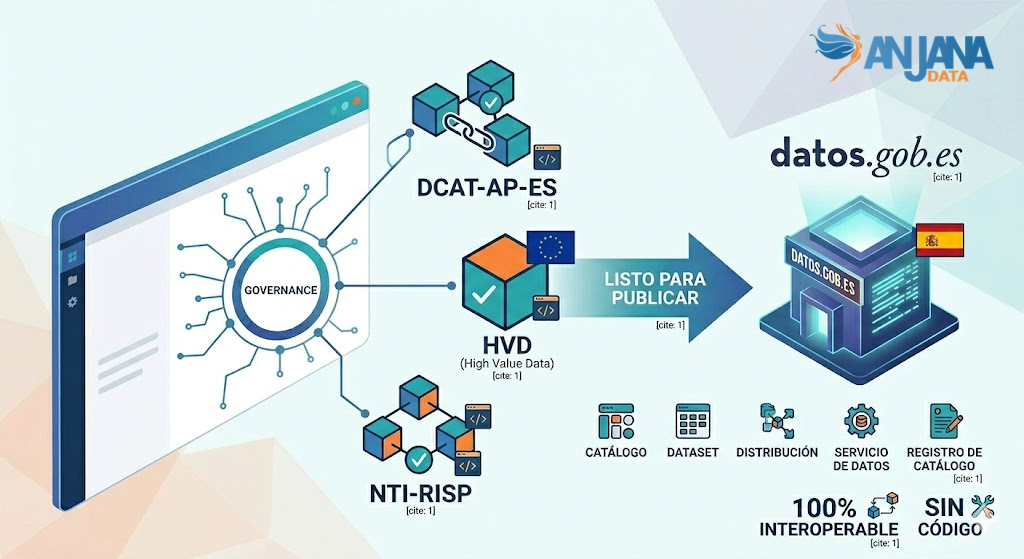
DCAT-AP-ES at Anjana Data is now a reality. At a time when public administrations and organisations operating in Spain need to publish their open data according to the Technical Interoperability Standard (NTI-RISP), having a solution that translates the standard into a real, frictionless, development-free configuration makes the difference between complying and leading.
We have analysed the application profile in depth DCAT-AP-EN (version 1.0.0), based on DCAT-AP 2.1.1 and the European High Value Data extension (HVD 2.2.0), and we have translated it into a full configuration and drop-down in Anjana Data Platform. The result: a solution that allows governing catalogues, datasets, distributions and data services according to the Spanish standard, ready to interoperate with datos.gob.es and with any European portal.
From the BOE to the platform: the standard made configuration
DCAT-AP-ES is not just a technical document. It is the framework that defines how open data should be described, classified and shared in Spain. But applying it requires mapping dozens of classes, mandatory properties, controlled vocabularies and validation rules.
We have already done this. The configuration in Anjana Data includes:
- 5 types of entity aligned with the classes of the standard: Catalogue, Dataset, Distribution, Data Service and Catalogue Record.
- 9 types of relationship that faithfully reflect the DCAT-AP-ES model: from the Catalogue-Dataset relationship to the lineage between datasets.
- More than 50 metadata attributes mapped one-to-one with the properties of the standard, using the technical nomenclature
dcat_ydcatapes_to ensure full traceability with the specification - 15 controlled vocabularies preloaded: NTI-RISP themes, EU Data Theme categories, licences, formats, update frequencies, geographic coverage by autonomous communities, High Value Data categories and more.
All this with native attributes name y description mapped to dct:title y dct:description, as required by the standard.
High Value Data (HVD) ready
The European High Value Data Regulation (EU 2023/138) sets specific obligations for datasets in six critical categories: geospatial, meteorological, statistical, mobility, business and environmental. DCAT-AP-ES incorporates these requirements, and so does our configuration:
- Dedicated HVD section in Dataset and Data Service with the fields
dcatapes_hvdCategoryydcatapes_applicableLegislation - HVD Category Vocabulary preloaded and ready to use
- Filter in the search engine to quickly locate all assets classified as High-Value Data
This means that organisations handling high-value data can comply with European regulations from day one.
Ready to deploy: no code, no friction
The DCAT-AP-ES configuration in Anjana Data is out of the box. This means:
- Implementation in record timeThe entire structure of menus, sections, attributes, validations and vocabularies is deployed in an automated way.
- No programming requiredconfiguration is applied directly through Anjana's administration API
- CustomisableThe following is an example: you can start from this basis and adapt menus, sections or attributes to the specific needs of each organisation, adding your own metadata without breaking compliance with the standard.
- Integrated validationsThe mandatory fields of the standard (title, description, publisher, subject, access rights...) are already configured as follows
REQUIRED, reducing cataloguing errors at source
Real interoperability with the Spanish and European ecosystem
The configuration has been designed with interoperability in mind:
- NTI-RISP Vocabulariessectoral thematic and territorial coverage aligned with the official resources of datos.gob.es
- Publishers as Organisational UnitsPublic bodies are modelled using Anjana's native selector, facilitating integration with the DIR3 Common Directory.
- Breakdown of contact pointscontact information (
vcard:Kind) is broken down into individual fields - name, organisation, email, phone, URL - for ease of completion and export. - Open REST APIall metadata governed in Anjana is accessible via API, allowing to feed open data portals, federations of catalogues and automated harvesting.
Three layers of lineage to visualise your catalogue
Beyond the metadata, we have set up three lineage layers that allow us to visualise the relationships between assets from different perspectives:
- Catalogue overviewshows the complete hierarchy Catalogue > Datasets > Distributions > Services, with groupings that allow each level to be collapsed and expanded.
- Data lineagetraceability between datasets, their distributions and the services that serve them, including relationships between source datasets.
- Governance of the catalogueManagement-oriented, showing catalogue records, sub-catalogues and the relationship of each record to the resource it catalogues.
10 search engine filters, ready to find what matters
The Anjana Data search engine is now configured with 10 specific filters for DCAT-AP-ES:
- Main filters (visible by default): Thematic, Publisher, Access rights, Geographical coverage and HVD Category.
- Secondary filters (on request): Language, Format, Date of publication, Date of modification and Frequency of update
Each filter is translated into English and Spanish, and linked directly to the controlled vocabularies of the standard.
A modular solution, ready to grow
DCAT-AP-ES is the basis, but Anjana Data allows you to go further:
- Add sectoral extensions (health, energy, geospatial...) on the same base configuration.
- Incorporate own metadata organisation in additional sections, without altering the conformity with the standard.
- Activate governance workflows for review and approval of metadata prior to publication
- Connect with open data portals to automate the synchronisation of existing catalogues
[VIDEO] DCAT-AP-ES configuration demo
We show you in detail what this implementation looks like on the platform:
Do you want to govern your open data according to the Spanish standard?
If your organisation needs to align your data catalogue with DCAT-AP-EN, comply with the High Value Data Regulation or prepare for the Data Act, now you can do it immediately, without development and with a solution 100% interoperable.
Get in touch with us to activate this setting in your environment, request a personalised demo or learn how Anjana Data can help you turn regulation into real governance.