
1st National Data Space Meeting
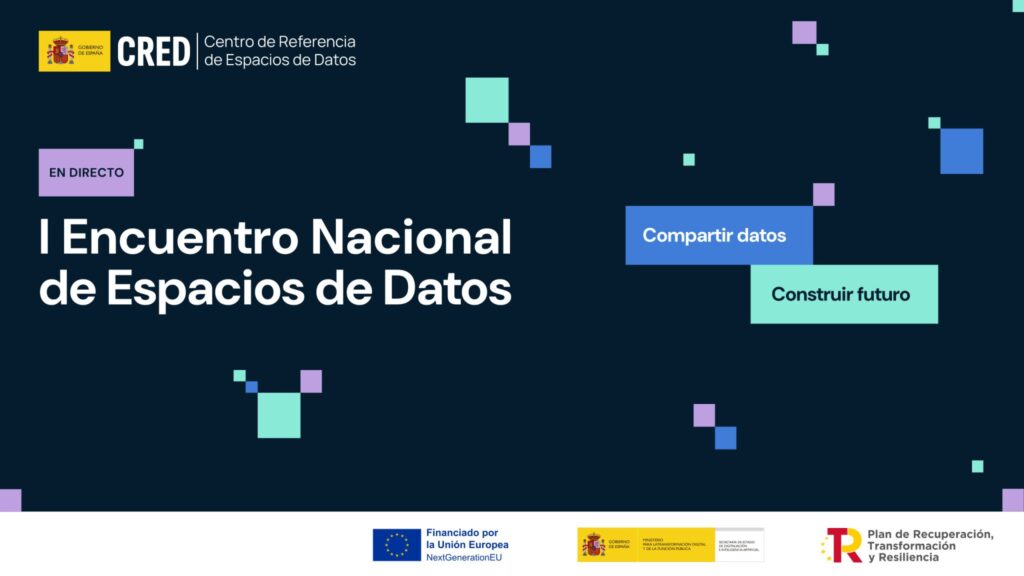
On 29 January 2026, Madrid hosted the 1st National Meeting of Data Spaces, organised by the Reference Centre for Data Economy (CRED) and supported by the Secretary of State for Digitalisation and Artificial Intelligence (SEDIA).
The event confirmed something that we at Anjana Data have been observing for some time in real projects: Data Spaces have moved beyond the conceptual phase and are entering a stage of effective implementation.
It is no longer a question of defining what a Data Space is, but how to operate it in production.
The conversation has matured: now the challenge is to execute.
Key issues such as interoperability, regulatory compliance, sovereignty and European standards were addressed during the various sessions. However, the real challenge is not strategic, but operational:
How is a Data Space technically deployed?
How do you govern in federated environments?
How do you ensure real control over the data when multiple actors are involved?
From our experience deploying real Data Spaces, we know that these questions require specific infrastructure, not just conceptual frameworks.
ADP4DS: Data Spaces Designed for Production
At Anjana Data we approach Data Spaces from a practical perspective: providing organisations with a platform ready to operate federated environments.
ADP4DS (Anjana Data Platform for Data Spaces) was born precisely to bridge the gap between institutional strategy and technical reality. It is not a theoretical framework or a set of best practices, but a platform designed to:
- Implementing effective governance in distributed environments
- Integrating European standards such as Gaia-X and IDSA
- Ensuring traceability and control over information assets
- Facilitating interoperability without losing sovereignty
Our approach starts from a clear premise: a Data Space is not a pilot project, it is a critical infrastructure.
Real, not declarative, interoperability
One of the recurring messages of the Encuentro was the need to move forward on open standards and federated architectures.
In our experience, interoperability is not only achieved by adhering to a reference framework, but by resolving specific technical issues:
-
Identity and trust management
-
Distributed access control
-
Data use policies
-
Secure connectivity between participants
ADP4DS integrates these components as a native part of the platform, allowing organisations to operate within a federated ecosystem without relying on ad hoc development.
From sovereignty discourse to effective control
Data sovereignty was one of the central themes of the event. However, sovereignty does not simply mean hosting data on European territory.
Meaning:
-
Deciding who gets access
-
Under what conditions
-
With what traceability
-
And with what capacity for revocation
In projects such as the Evidenze case study, we have demonstrated that it is possible to put into production a Data Space with effective control over shared assets, while maintaining the autonomy of each participant.
It is this practical experience that differentiates a mature technological approach from an exploratory initiative.
Spain accelerates. Now it's time to climb
The 1st National Meeting of Data Spaces shows that Spain is aligned with the European agenda and determined to consolidate strategic sectors such as health, industry or mobility through shared data infrastructures.
The next step is to scale up.
Scaling up involves moving from funded pilots to stable environments.
It involves industrialising governance.
It involves operating Data Spaces with technical, regulatory and organisational safeguards.
At Anjana Data we will continue to contribute to this transition with a clear conviction:
Data Spaces are not a future promise.
These are infrastructures that must work today.
And for this, they need production-ready technology.