
Are GARTNER® Data Mesh and Data Fabric the same or different?
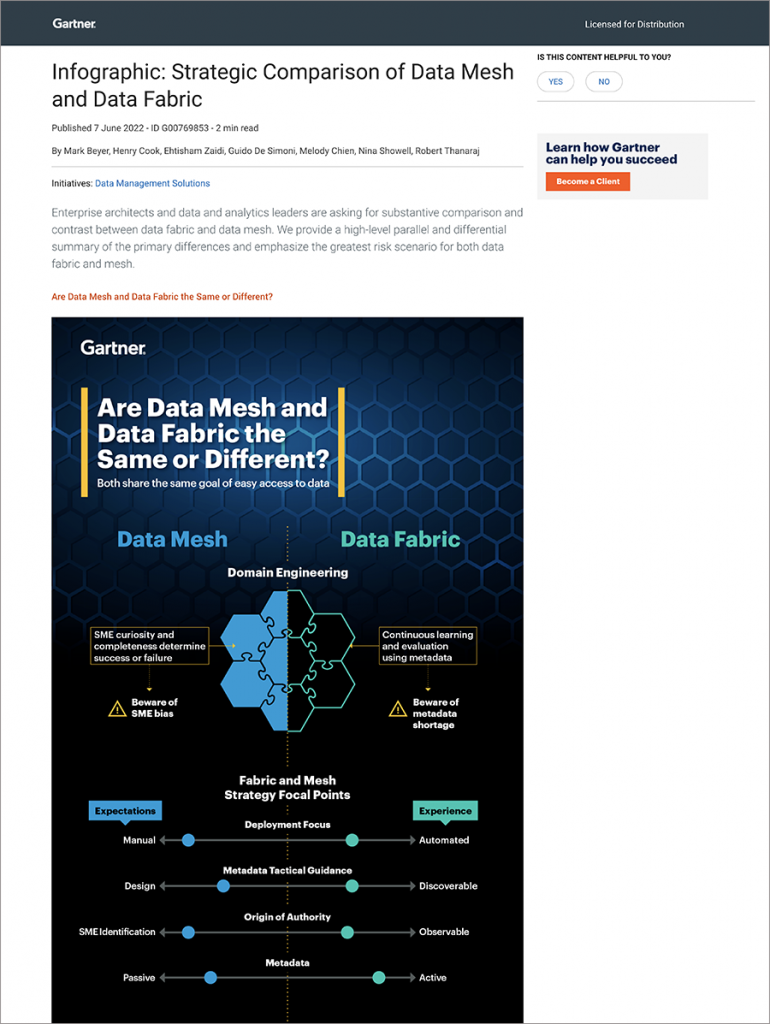
Below is the infographic ‘Strategic Comparison of Data Mesh and Data Fabric’, a document that provides a high-level summary of the main differences and emphasises the highest risk scenarios for both approaches.
To understand the scope of this infographic it is important to know that it is based on the market experience of Gartner clients and the broader experience described by the communities of interest. At the time of publication, less than 1.5% of the global IT market had direct experience with either approach but already anticipated exponential growth in their level of adoption over the next 3-5 years.
By their very definition, Data Mesh and Data Fabric are two concepts linked to data architecture and infrastructure that aim to improve data management and integration between different systems, applications, and users. Most organisations believe they have to choose between Data Fabric and Data Mesh; however, according to Gartner (and we agree), this is a false dichotomy and should be avoided: they work both separately and together, although it is true that the value they can bring together is much greater than separately: Data Fabric addresses challenges from a perspective closer to the technology platform (technology as a means), while Data Mesh is more oriented towards the vision of how our data architecture should be in order to generate data products (the ultimate goal is the creation and management of data products to generate value for the organisation).
Organisations use data to generate business value but they must do so not only effectively but also in a secure, controlled, and efficient way, so beyond the technicalities, the goal must be to create a data ecosystem that is business-oriented and built on a solid IT foundation.