
What value-added features should I look for in the technological solutions that support my Data Governance?
Although the Data Governance It mainly deals with cultural and organisational aspects and cannot be resolved solely through technology, although technological solutions play a fundamental role and are more than necessary to achieve the implementation of an effective and efficient governance model. That is why there are many solutions on the market that serve as accelerators for achieving good data governance, as well as helping organisations to build and maintain the data culture necessary at all levels to achieve the goal of becoming data-driven.
From the version 2 of the DAMA-DMBOK we can draw some very interesting conclusions:
- Organisations that establish a formal Data Governance programme are much better equipped to increase the value they derive from their data assets.
- The Data Governance function guides all other Data Management functions.
- The purpose of the Data Governance is to ensure that data is managed appropriately, in accordance with a series of policies and best practices.
- Data governance focuses on how decisions are made about data and how processes and people are expected to behave in relation to data.
- Data governance is not an end in itself; it needs to be directly aligned with the organisation's strategy.
- Data governance is not a one-off exercise; it requires an ongoing programme focused on ensuring that the organisation derives value from its data and reduces data-related risks.
- Data governance is different from IT governance.
- The objective of the Data Government is to enable the organisation to manage data as an asset.
- A Data Governance programme must be sustainable, embedded and measurable.
- Data governance cannot be implemented overnight and requires planning.
In short, the fact that the Data Governance The fact that it is so closely linked to these cultural and organisational aspects makes evaluating the technological solutions that can support us in this area difficult and complex. This forces us to broaden our horizons beyond an evaluation based on the coverage of available functionalities or modules and also consider a series of value-added features that we must incorporate into the assessment.
Features and modules
On the one hand, if we consider the functionalities and modules “specific” to Data Governance, we can mention:
- Glossary of business terms
- Metadata management with Dictionary and Catalogue
- Data traceability and lineage
- Architecture, design, and data modelling
- Workflow and business process management
- Master and reference data management
- Data quality
- Data incident management
- Data security (policies, access and use, user roles and profiling, data obfuscation)
- Dashboard
- DataLabs and Sandboxes Management
- Content Management and Publishing Portal
- Data services management
- Audit support
However, evaluating a solution solely on the basis of the completeness of these functionalities will mean that we only see part of the picture and may make a decision that we regret later on, especially when it is utopian to think that a single technological solution can accommodate all these functionalities in a self-contained manner. That is why, to ensure that this does not happen, we must weigh up the analysis of feature coverage alongside another type of analysis based on a series of value-added characteristics.
Value-added features
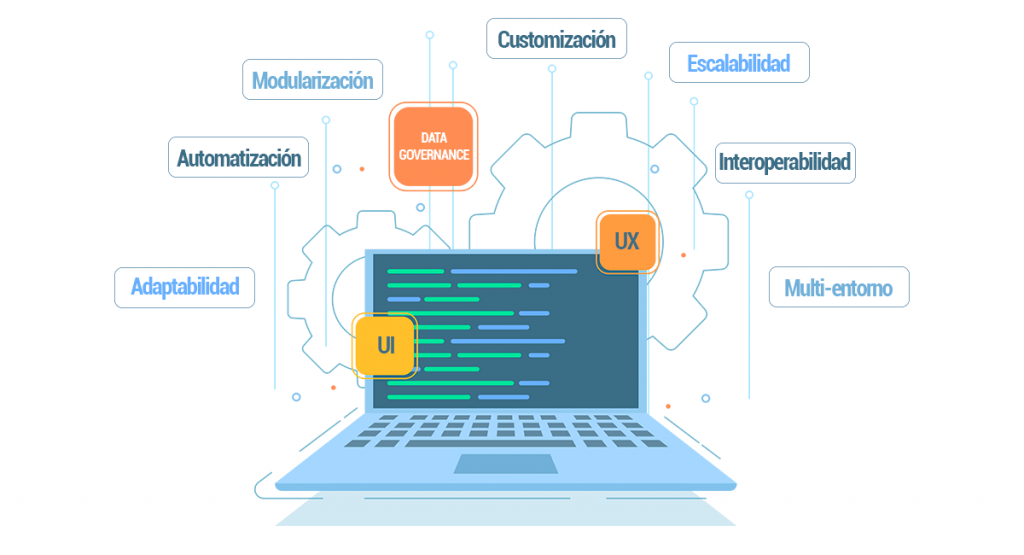
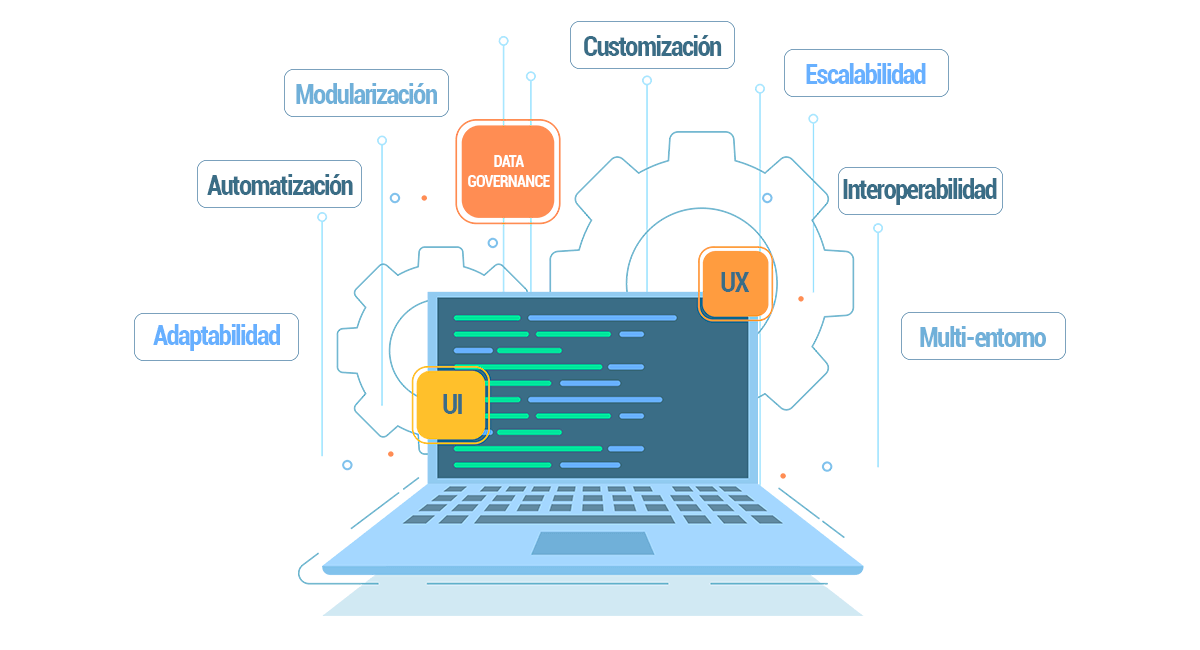
These features will enable us to grow in the role of Data Governance in a timely manner according to the specific needs of the organisation:
- Automation: processes should be as automated as possible to free users from the burden of using tools.
- UX & UI: The user interface, as well as its navigation and usability, must be as intuitive and user-friendly as possible for all types of audiences, so that any user feels comfortable using it.
- Interoperability: it must be able to share and exchange data with other systems; it must not be a “black box” or a closed component, allowing interconnection with different types of systems through connectors and enabling the use of standards.
- Customisation: as configurable as possible in order to support the strategy and governance model defined by the organisation.
- Modularisation: the different functionalities should be understood as independent parts, so that the use of one does not limit the use of others, allowing the necessary modules to be used without compromising the overall experience.
- Multi-environment: the ability to centrally manage multiple platforms supported by different technologies from a single instance.
- Scalability: adaptable as data volume and processing and response requirements increase, maintaining stable performance over time.
- Adaptability: it must be able to adapt to the needs and realities of the organisation over time.
Additionally, from a longer-term perspective, the characteristics that require special attention and care are:
- Vendor lock-in: as far as possible, efforts should be made to ensure that the solutions selected do not “tie” the organisation to a single vendor acquiring large dependencies and thus avoiding the migration from one solution to another having major consequences.
- Learning curve: as powerful solutions, the learning curve should not be a problem for users, who should not have to invest a large number of hours in learning how to use the solution or require very specific and costly training and certification.
- User limit: If we want to extend data governance to the entire organisation, we must consider solutions that do not license by user, as this can result in limited use of the solution due to skyrocketing costs in relation to the increase in users and not based on actual use.
- Licence cost: the cost must be flexible and scalable, tending towards pay-per-use, allowing total control over ROI without requiring a high initial investment to maximise the time to market and the time-to-value.
What can we find on the market?
Looking at the market, given that we are talking about technology, the manufacturers of data storage and processing solutions themselves often offer modules geared towards data governance within their own platforms, but generally with a biased and poorly interoperable vision, representing an integration problem between technologies and resulting in a new challenge of application and technology governance.
On the other hand, given the existing market need, in recent years new providers have emerged that specialise in developing specific, independent solutions with an agnostic approach to data storage and processing technologies, providing this practice with a new set of tools to facilitate its implementation. This group includes, for example, Anjana Data.
Despite this, due to the complexity and breadth of the practice, solutions tend to focus on offering a series of specific functionalities and capabilities, and it seems very difficult, if not impossible, to find a single solution that covers everything. Therefore, it is advisable to look for the different pieces that help us build the puzzle of solutions that support Data Governance based on the needs of the organisation, starting with the most critical aspects.
In addition, the market for specific solutions for “Data Governance” It has not been around for very long and is not widely used, except in the US, where it does represent a high volume of business. In fact, neither Gartner nor Forrester have yet created a quadrant or curve for this area, with solutions falling under “Metadata Management”, “Master Data Management” and “Data Quality”.
Finally, within the spectrum of Data Governance technology solution providers, we can group vendors into different categories... but that is a topic for another article entirely.