

Anjana Data V4.3 incorporates new, more dynamic and interactive components into its Data Governance solution.
Following the same line that has led to Anjana Data In order to become one of the most innovative and disruptive Data Governance solutions on the current scene, we present the new version 4.3, which brings a series of relevant evolutions and improvements in terms of the design of the entire tool, with new advanced UX & UI capabilities to improve the experience of different types of users, as well as improvements in the performance of the solution and some other new features in terms of functionality coverage.
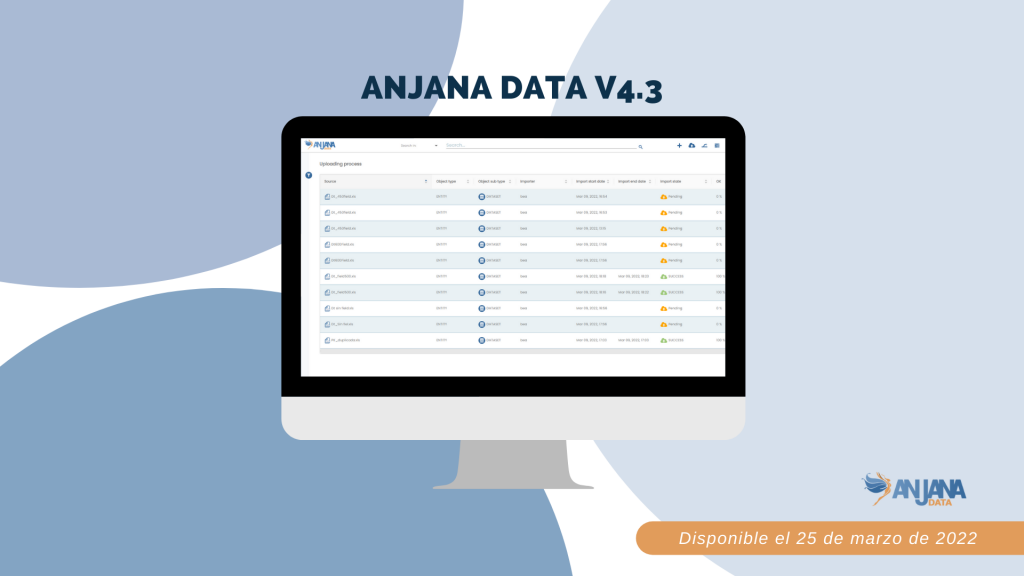
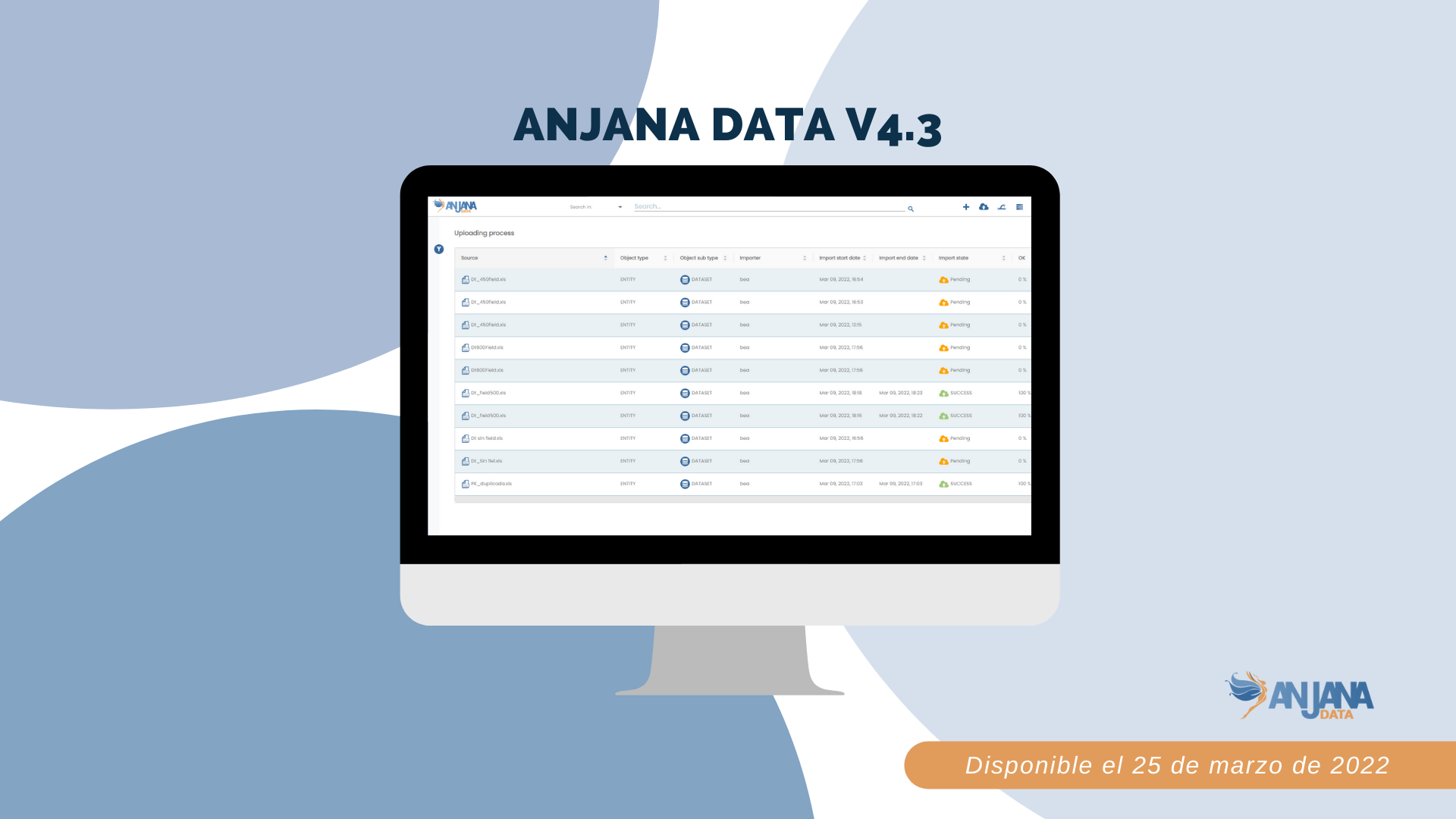
The evolution in UX & UI design is one of the most significant changes in the new version of Anjana Data, including general improvements in the dynamic forms, the evolution of the designs of some UI screens unifying colours and styles, the introduction of graphic and intuitive elements to facilitate the interaction of users with the application and the creation of new screens for the massive management of objects.
The new multilingual management capabilities is another of the differential points to be highlighted with respect to other solutions for Data Governance. In addition to having a multi-language interface in previous versions, this new 4.3 version allows the configuration of different languages for managing the content of the metadata attributes of the governed objects. This option also applies to practically all the functions of the tool, from auditing related to the governed objects to the notifications of the solution itself.
In addition, it is also worth noting the evolution in mass object management capabilities, Anjana Data 4.3 includes the functionality of mass editing of objects from the UI for those users who have the corresponding permission configured. Thanks to these changes, the user will be able to mass-edit a list of attributes for several objects of the same subtype.
Anjana Data 4.3 also includes a evolution in the configuration capabilities of validation flows, allowing the complete evaluation of the object at the start of any workflow in order to be able to design alternative paths according to any attribute and logical rules. Additionally, it incorporates the possibility of configuring attributes for which it is not necessary to launch a validation workflow.
Another of the most relevant aspects to be highlighted is related to the snapshot management, given that this version makes it possible to download snapshots of the objects governed both from the Anjana Data UI and from the APIs. Thus, the user will be able to download a snapshot with all the information of the object at any time of its life cycle in order to know the snapshot of an object at a given moment.
The latest version of Anjana Data also includes improvements to the role and permissions management, It adds the possibility of assigning a default role to users who register for the first time in Anjana. This role grants the configured permissions to users who, initially, do not have a specific role in the application. In addition, it also incorporates the use of user and role cache to improve the performance of the application, and an alternative internal authorisation mechanism that avoids the need to use an external identity management system.
Finally, improvements with respect to the architecture The main focus is on upgrading to the latest version of Angular, design improvements thanks to the incorporation of the ng-zorro library and the use of grids for graphical interfaces, improved performance of microservices, centralisation of UI error management, inclusion of kubernetes operators for various modules and the availability of two new kits: one for deployment automation using Ansible and the other for advanced monitoring of the platform with Prometheus and Grafana.