
Anjana Data incorporates new features, improvements and native integrations into its Data Governance solution
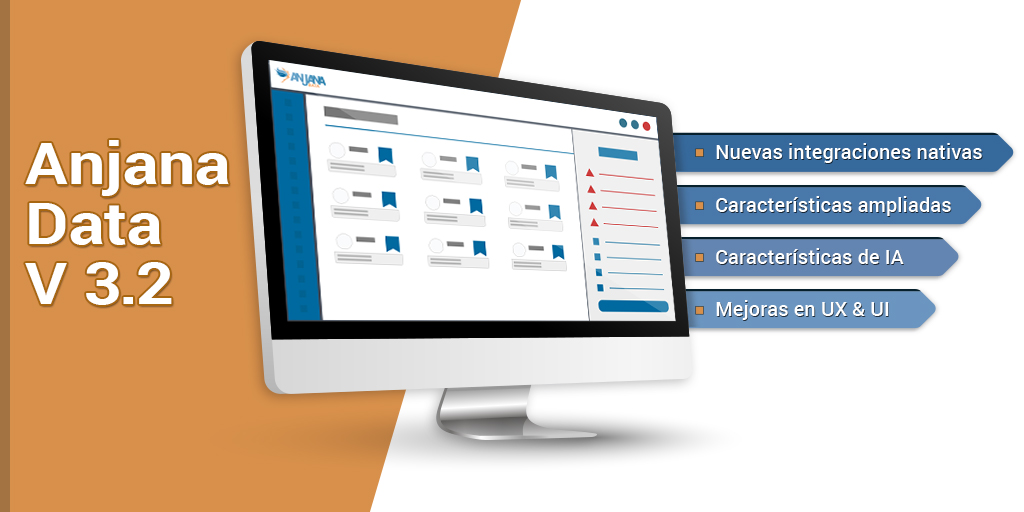
Anjana Data announces a new version of its Data Governance solution with new functionalities, available from 15 July.
The new version of Anjana Data incorporates extended features for the Business Glossary such as the ability to create new entity types with their own attributes based on dynamic forms. Many of the enhancements are aimed at UX & UI, audit functions as well as back-end and architecture improvements; the incorporation of Artificial Intelligence for user assistance, new workflow configuration capabilities. The new version also features new native integrations.
“In this new version of Anjana Data we have focused on building on what the solution already offered, especially improving the user interface design and providing a better user experience. In parallel, we have invested a lot of time and effort in extending the native integration capabilities to offer proactive and preventative governance over data platforms such as Azure, AWS, Denodo, Snowflake, as well as Cloudera and Hadoop. Finally, we can already say that we have the first user assistance use cases based on Artificial Intelligence & Machine Learning algorithms. In any case, version 4.0, which will be released at the end of September this year, is going to be a new turning point, we are at an incredible pace for a company of our characteristics”.” says Mario de Francisco, CEO of Anjana Data.
Extended features for the Business Glossary
Anjana Data aims to become one of the benchmark solutions in the world of Data Governance with a approach innovative and disruptive, bridging the worlds of business and technology and offering adaptability and flexibility capabilities hitherto not offered by any other solution, which are more than necessary in the new era of Big Data & Multi-Cloud.
That is why in this new version, Anjana Data incorporates improvements in the management of permissions and privileges in the Enterprise Glossary, based on the defined governance model. In addition, it offers the possibility of creating new types of entities with their own attributes based on dynamic forms. In this way, the organisation can create as many entity types as it wishes (i.e. metrics, reports, business rules, data quality rules, KPIs, ...).
Regarding the relationship between objects, Anjana Data includes extended attributes and can also create different types of relationships to classify them from a semantic point of view. Each object can be related to any other object not only within the Business Glossary but also to any object within the Data Catalogue. When creating the objects and defining the associated template, attributes can be set as mandatory or optional.
UX & UI improvements
Other enhancements in the new version relate to navigation between objects throughout the user interface. In Anjana Data, an object is any element within the metamodel that contains metadata attributes.
To optimise the user experience in the Business Glossary, Anjana Data incorporates a new wizard for the creation of objects. This is especially useful as the wizard will guide the user to facilitate the creation of new objects regardless of type (any type of entity and any type of relationship) and the user will be able to choose between manual creation or import from an Excel spreadsheet based on the names of the headers without requiring a fixed structure.
Anjana Data has also introduced an improved view of each object showing in its main view the most important and recent information related to it and a new section within the object view showing all users of the object.
AI features for user assistance
Anjana Data is advancing its AI-powered features and a new module has been integrated into the solution architecture for user support based on metadata information, data profiling techniques and user behaviour.
In this new version, the corresponding algorithms run in the background and will show recommendations to users in a non-invasive way. Algorithms for specific use cases will be released within future updates, with the first ones included in this release:
- Recommendation of business terms that may be of some interest to the user.
- Recommendation for the generation of new relations between objects within the Business Glossary.
Enhanced auditing functions and new workflow configuration capabilities
While Anjana Data has put the main focus on user experience improvements, another important part of this new version is the auditing functions. Thanks to the Minerva (based on SolR) it is now possible to see more detailed information in the internal audit logs, as well as having the possibility to select which actions should be audited and which should not.
Thus, each time a value of any attribute changes, a snapshot of the object will be saved to allow the regeneration of an object with the corresponding values at a specific point in its history.
The new version also introduces new configuration capabilities in the validation flows through the module Hermes (based on Activiti BPM), allowing the possibility to define the triggering of parallel validation steps within a workflow configuration and the dynamic generation of validation steps depending on the type of object, the action performed and the user who has performed this action.
New native integrations
In terms of native integrations, thanks to the new plugins added to the modules Tot y Heimdal, In addition, different types of integrations have been developed between Anjana Data and the technologies used within various data platforms.
Metadata collection and import, sample data query, active governance and dynamic data lineage capture (if applicable) are now possible on the following technologies:
- RDBMS supporting Generic JDBC
- SAML 2.0 & OAuth based identity access management systems
- Cloud-native technologies from Microsoft Azure and AWS
- Denodo (Beta version)
- QlikSense (Beta version)
- Snowflake (Beta version)
- Confluent & Apache Kafka (Beta version)
From 15/07, Anjana Data v3.2 will be made available to users interested in discovering how Anjana Data can add value to the data strategy, changing the vision of Data Governance in an organisation. The company is also already working on a new version v4.0 (planned for the end of September 2020) which will again be a turning point in the evolution of the solution.